Akron History Center to be “Home Base” for Downtown Walking Tour December 6
November 29, 2025
The City of Akron will conclude the celebration of its founding 200 years ago by coming “full circle,” and ending the year where city founder General Simon Perkins launched the City at the Summit in 1825.
Closing ceremonies sponsored by the Akron Bicentennial Commission will take place Saturday, December 6 at 1:00pm at Perkins Square on the Children’s Hospital campus at the corner of West Bowery and West Exchange streets in the amphitheater outside the Kay Jewelers Pavilion. In case of inclement weather, the ceremony will be moved indoors to the auditorium of the Considine Professional Building.
“This location is meaningful,” says Dave Lieberth, Executive Secretary of the Commission, “It is described as the ‘Public Square’ on the original plat of Akron created by Joshua Henshaw in the summer of 1825.”
Perkins, a surveyor for the Erie Land Company who came to the Western Reserve as a 27-year-old, carved out property for himself that would become modern-day Akron. With Paul Williams, a farmer who owned land near the intersection of today’s Broadway and Buchtel, the pair filed the plat for the town of Akron at the Portage County courthouse on December 6, 1825. The town’s name comes from the Greek, akros, meaning “high point “or “summit.”
“Saturday is an opportunity for families to discover all the historic markers, monuments and exhibits in Downtown Akron,” says Lieberth. “A good place to start is the Akron History Center that features 62 exhibits, 30 flat video screens, 22 PowerPoints, and 150 artifacts on display.”
The Center, located at 172 South Main – adjacent to Lock 3 and the Civic Theatre – will be open 10am – 2pm on December 6.
A historic walking tour of landmarks, monuments and markers has been prepared by the Akron History Center (BELOW).
The closing ceremony will feature remarks from local historians and government officials. Mayor Shammas Malik will unveil a new logo for the City. The initiative was introduced a year ago and garnered public comments on a variety of options presented by local artists and designers.
Additionally, awards will be announced to participants in the year-long Akron Marathon Bicentennial Wellness Challenge that allowed residents of all ages and ability levels to set their own personal wellness goals by completing 200 wellness activities, including biking, hiking, swimming, strength Training or other activities.
To close out the year, submissions will be accepted for the Bicentennial Time Capsule to be opened in the year 2050. Families may provide letters, essays or photos to be included in the capsule. Submissions will be accepted during the month of December at Lock 3 and at the Summit County Historical Society office behind the Perkins Mansion, Wednesdays – Saturdays from 1-4 pm. The Bicentennial Commission unveiled contents in July of a previous time capsule created for the 2000 Centeseptequinary. The 25-year-old memories are archived with the Summit County Historical Society.
A Walking Tour of Historic Locations in Downtown Akron
- The Akron History Center, 172 S. Main, at Lock 4, adjacent to Lock 3 and the Civic Theatre
- The canal Towpath continues to Lock 2 behind Canal Park stadium.
- At Lock 2, explorers can take the trail on the west side of the lock to the Considine Building on Bowery. Along the way there are two historic markers to Irish immigrants who built the canal, and who endured the difficulties of migration following the Irish potato famine.
- On Bowery Street at the corner of State Street, there is a plaque remembering the Polio Epidemic when Children’s Hospital played a major role for the State of Ohio.
- On West Exchange Street east of Bowery are the offices of the Ohio & Erie Canalway Coalition, an 1836 high-style Federal structure that was the home of Canal engineer Richard Howe.
- On Main Street at Exchange, there is a plaque on the side of the Evans building marking the location of Henry Clark’s Tavern, where Akron’s first mayor was elected in 1836.
- On East Exchange at High Street, there is a plaque honoring the work of John S. Knight, publisher of the Akron Beacon Journal.
- On South High Street at University Ave is the Eternal Flame dedicated to Akron police officers who gave their lives in service to residents.
- At the cul-de-sac on University Avenue at the Goodyear Polymer Center is the historic marker commemorating the U.S. Synthetic Rubber Program during World War II.
- In the Summit County Courthouse on High Street, there is a plaque honoring Wendell Wilkie, a lawyer advocate and a presidential candidate in 1940.
- On High Street at the Courthouse is the “Spirit of the American Doughboy” statue honoring veterans of World War I.
- On High Street at the Courthouse is the “Centennial Boulder” erected in 1925.
- Adjacent to the Courthouse there is a statue to Charles Goodyear, who never visited Akron, but whose invention of vulcanization led to the city’s becoming the world’s Rubber Capital.
- On Mill Street at High is a state historic marker recalling the sit-down strikes by the United Rubber Workers. For many years this was the location of the URW’s national headquarters.
- On North Main Street, adjacent to the Akron Public Schools Administration building, is a historic marker remembering the founding of the United Rubber Workers Union by John L. Lewis at the Portage Hotel in 1935.
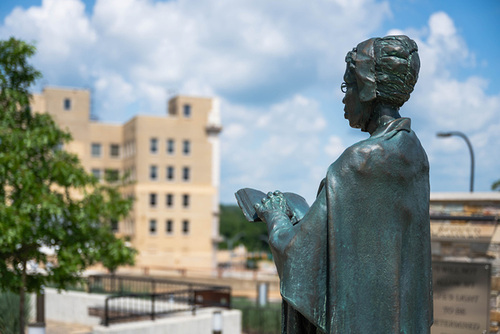
- On North High Street at the United Way Plaza is the statue created by Akron artist Woodrow Nash dedicated to Sojourner Truth
- On Perkins Street at Prospect is a state historic marker to Wesley Temple AME Church.
- On Perkins Street at North Howard Street is the monument to the Matthews Hotel that hosted America’s jazz music greats in the 1930’s and 40’s, and nearby is a state historic marker remembering Howard Street’s Jazz history.
- On North Howard at North Street is and the Mustill Store and the Cascade Locks Park, with a memorial to Ferdinand Schumaker’s cereal mills.